Get Started


Key Takeaways
Recurring revenue is crucial for stability. Diversifying income with subscriptions and retainers reduces feast-and-famine cycles, ensuring predictable cash flow.
Website maintenance packages boost client retention. Offering monthly services like updates and backups can lead to upselling opportunities and steady income streams.
Resource libraries can scale revenue efficiently. Bundling assets into a subscription model allows for scalable income growth without proportional time investment.
Ongoing consulting calls enhance client relationships. Providing strategic advice post-project completion can lead to long-term partnerships and increased revenue.
If there’s one thing that’s frustrating about running a small agency or freelance business, it’s the unpredictable income. Oh, the unpredictable income.
You can fall into cycles of feast and famine, going between booked-out for months and scrambling for last-minute work. Meanwhile, as you search for ways to scale your business, you might also be nervously browsing job sites for the new 9-5 you’ll surely have to apply for.
Your income is tied to your time, so your earning potential is capped by how much you can work. Aside from raising your prices, finding ways to scale with recurring, predictable projects and revenue is key to your long-term success.
Plus, knowing in December how much money you’re going to make in April makes planning other areas of your life way easier. For example, planning a vacation for months away is terrifying when you don’t know yet where your income will be coming from that month.

So how do you diversify your income while playing to your existing strengths?
Here are a few ways you can boost your agency or freelancing business by adding recurring revenue products and services.
What’s Recurring Revenue (and Why do you Want It)?
Recurring revenue is the part of your business income that repeats from month to month. New clients or customers pay on a recurring basis, usually monthly, instead of just a one-time purchase.
This can take the form of many different business models. Products and services can be structured around a monthly subscription or membership fee. You can offer retainer packages for services. You can even switch your existing freelance packages over to a more spread-out payment plan so that income from those clients is recurring over time.
Why does this matter?
Working project-to-project can be notoriously unpredictable, and the experience of losing a client on short notice often teaches us to diversify our income ASAP.
But a lot of the go-to tactics for that, like creating a product or second business, can take learning a bunch of new skills.
Adjusting and supplementing your services so that they build in more recurring revenue lets you work with the skills and clients you’ve already got.
The recurring revenue strategies I’m going to talk about all work well as supplements or add-ons to larger freelance web design work and can take advantage of the branding, assets, and contacts you’ve built in your business already.
1. Offer Website Maintenance Packages
The most common recurring revenue package you’ll see with web designers is probably monthly retainers for website maintenance. In fact, this is the whole model for WP Curve’s entire business:

There are lots…and lots, and lots, and lots…of people and businesses out there who are intimidated by their websites. This can range from people wanting to outsource more complicated website tweaks between full redesigns to people who don’t ever want to have to log into their WordPress sites.
That means there’s a large range of services you can include in this package, most of which will be easy tasks for you. They’re just scary to those less familiar with WordPress.
Your services could be as simple as offering:
- Website and content updates (where they send you content to put live/update)
- Plugin updates, installations, and customizations
- Performing regular site backups
- Small design tweaks (putting limits on time or intensity required)
For a small monthly package offering simple services, you’ll be able to take on a larger number of clients per month. This revenue model works well because you can perform the work in bulk, quickly, and schedule it around your bigger projects. You can set aside a set window of time each day, or one day per week, to do work on all of your maintenance clients at once.

Plus, a maintenance package is a great upsell to site owners after they’ve worked with you — once you’ve finished their website, you can offer to update and maintain it every month.
Or, if someone hasn’t worked with you on a larger project yet, site maintenance provides a strating point fo ryou and the client to see how well you get along and work together. If a current maintenance client then needs design work, you’ll be at the top of their mind and have an established relationship already.
2. Offer a Resource Library Subscription
We end up creating a lot of content for our businesses.
First, there are all of the assets we use in our client processes, like surveys, video tutorials, and checklists. Then there’s any marketing content we create, like emails, blog posts, or free training courses.
Then there’s things we create to make our own jobs easier.
Why not bundle these up and offer them to others? Then offer a monthly subscription for access. You can include things like:
- Free PDF worksheets made from client questionnaires
- Video trainings you’ve recorded for clients or team members
- Exclusive blog posts, emails, or articles sharing insider tips
- Members-only webinars or Q&As – some kind of access to you
That’s what Lauren Hooker, web designer at Elle & Company, does with her subscription service, The Library:

While she takes care of web design, this service offers clients and customers help with other areas of their business, like branding, finances, and organization.
Resource libraries can also be a great tripwire or a smaller, low-priced offer that’s easy for people to say “yes” to. Once someone has bought the smaller offer from you and you’re building trust and loyalty with them, you can easily upgrade them to design clients later.
You can also create resources that appeal more to past or current clients — the options are endless depending on what part you want the library to play in your business!
Plus, resources can scale. Unlike website maintenance, which still ties a certain amount of time to each retainer client you take on, the resource library is more of a digital product than a service.
Whether you have five or 500 members paying you, offering a resource library takes pretty much the same amount of work each month. So as that part of your business revenue grows, your time spent on it doesn’t have to.
3. Offer Ongoing Consulting Calls
Another way to offer existing services to past clients or prospects is through ongoing monthly, bi-monthly, or weekly calls with businesses to discuss their website or digital strategy.

You could even branch out with additional topics like online marketing or helping other web designers establish their careers. It depends on where you want this to fit into your business and where your expertise lies, but it could look something like:
- Consulting a less experienced, in-house designer with overall strategy behind smaller changes
- Helping a business optimize websites for conversions (CRO)
- Offering advice on marketing or social media strategy
- Making recommendations for ad campaigns
- Helping aspiring freelancers establish their careers in your footsteps
For example, if you want to position consulting as a service for existing clients once their web design is finished, you can recommend ways to promote their site and help drive new business, and, you get to show off your finished product in the process.
From there, you could schedule ongoing calls to discuss and make recommendations on the client’s overall digital strategy, leading people to and converting them from their websites.
Strategy work can scale well because you can increase prices as your expertise increases, similar to your other work, but the time output won’t increase. This is unlike improving your design expertise, which is often used for more complex and time-consuming work.
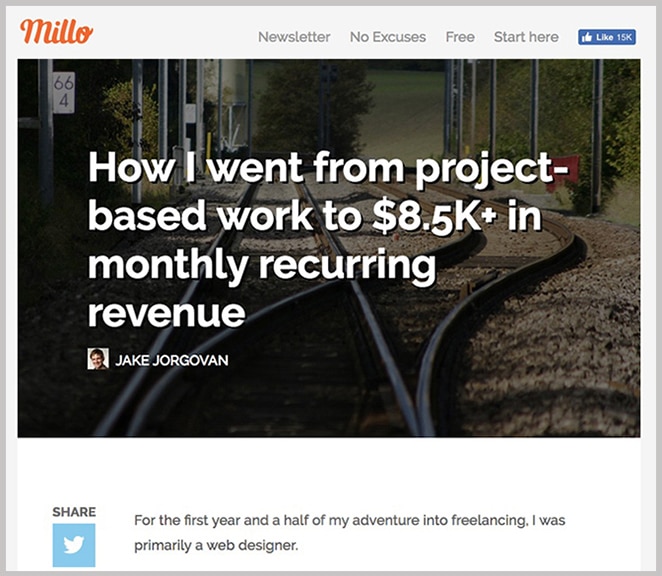
Because of this, Jake Jorgovan of Outbound Creative was able to build his business up to $8,500 per month in monthly recurring revenue. Although he phased out project-based web design work in the process, you can of course use strategy consulting to supplement your project-based clients instead.
4. Resell Subscriptions or Become an Affiliate
Next up is reselling subscriptions for things like website hosting or becoming an affiliate for website-related tools and services. This branches out a little more from providing services and resources, but it can easily fit within your current business anyway.
For web designers, the easiest place to start is somewhere like reselling web hosting, where you purchase hosting services in bulk at a discount, and then resell it to your clients.
Additionally, you can become an affiliate partner for other tools your clients might need. This way, when you refer customers, you get a commission, and it’s less involved for you than reselling.
Some, but not all, affiliate programs offer recurring revenue payouts. Specifically, tools with monthly subscriptions often have a recurring commission structure, so you earn a monthly commission for as long as a referral remains a customer.
You could then promote these services on your website and social media, recommend them to clients, and more. Some tools a business might need for their online strategy include:
- WordPress plugins and services such as backup tools
- Email marketing software
- Social media marketing software
- Graphic design tools
- Project management software
- E-commerce platforms
I’ve personally used affiliate marketing to build up several hundred dollars more of recurring revenue each month, and only added the income stream to my business earlier this year.
5. Offer Payment Plans on Existing Services

Lastly, a recurring revenue model you could implement in about 15 minutes is simply changing your current payment options to include more and longer payment plans.
This will only make sense with your specific service packages to an existing extent. For example, working with a client for one month with an eight-month-long payment program sounds logistically risky.
But if you only have payments for longer-term projects broken up into two or three payments, consider breaking them up further.
This isn’t necessarily adding a new source of revenue to your business, like the other options discussed in this post, but for lots of us, that’s a good thing.
It’s simple, easy to implement, makes your existing income more steady and predictable, and it can make things easier on prospective clients. The details of a payment plan may be the difference between a yes or no with a prospect who likes your work but is on a tight budget.
“Pay it Again, Sam”
Recurring revenue is key to adding more predictability and stability to your design business without throwing the whole thing through a loop.
You don’t have to learn how to create and sell products.
You don’t have to start a second business.
All you need to do is leverage the services you’re already performing and the relationships you already have for a little bit of extra work per month.
A Suite of Tools for Agency and Freelancer Growth
Are you looking for another way to grow your agency business and build MRR? Flywheel Growth Suite was built specifically for agencies and freelancers who are ready to break out of the project-to-project mindset and take their business to the next level. Check out the video below to find out more:
Flywheel Growth Suite is your virtual assistant, keeping track of all the billing, site maintenance, and client communication aspects that power your creative business forward, allowing you to to spend more time on the important stuff. Ready to get started? Find out more here.