Get Started

Key Takeaways
High-volume newsrooms frequently experience severe operational drag and technical bottlenecks when relying on fragmented, plugin-heavy content management systems. Transitioning to unified system architectures minimizes dependencies, eliminates editorial friction, and accelerates content distribution.
Modern editorial governance frameworks introduce custom workflow guardrails directly within the content editor to prevent costly publishing errors and safeguard brand consistency.
Digital asset management integrations within the core publishing platform allow content creators to access pre-approved media libraries without external file transfers. This streamlined asset workflow effectively protects publishers from licensing compliance risks while substantially increasing creative speed.
Media executives should systematically audit their current technical infrastructure to eliminate operational friction and phase out disconnected third-party technologies. Prioritizing unified platform features over plugin patchworks ensures greater system stability and empowers newsrooms to focus entirely on journalism.
High-volume newsrooms require a suite of essential CMS features to maintain peak editorial velocity, protect brand standards, and eliminate technical debt. This guide explores must-have capabilities for modern publishing, including integrated workflow governance, native live-blogging, code-free engagement blocks, and digital asset management integrations that empower editorial teams to scale content production without engineering bottlenecks.
The distance between “breaking news” and “published news” is shrinking to seconds. For high-volume newsrooms, the challenge isn’t finding the story, but navigating the digital hurdles required to get it in front of an audience quickly, accurately, and profitably.
Too often, media organizations find themselves slowed down by a fragmented patchwork of disconnected tools. While each individual piece of software serves a purpose, the lack of cohesion between them creates a significant operational burden. Every minute spent troubleshooting a plugin conflict or manually double-checking metadata is a minute lost in the race for the scoop.
To maintain a competitive edge, your news content management system must move beyond being a simple text editor. It needs to function as a unified operating system for your entire editorial team.
This article provides a checklist of the non-negotiable features every modern, high-volume newsroom needs to work together if they hope to scale without the technical setbacks.
Embedded editorial governance
In a fast-paced environment, mistakes are expensive. Whether it’s a missed author tag, a forgotten SEO description, or a legal disclaimer that didn’t make it into the final draft, manual mental checklists are prone to human error.
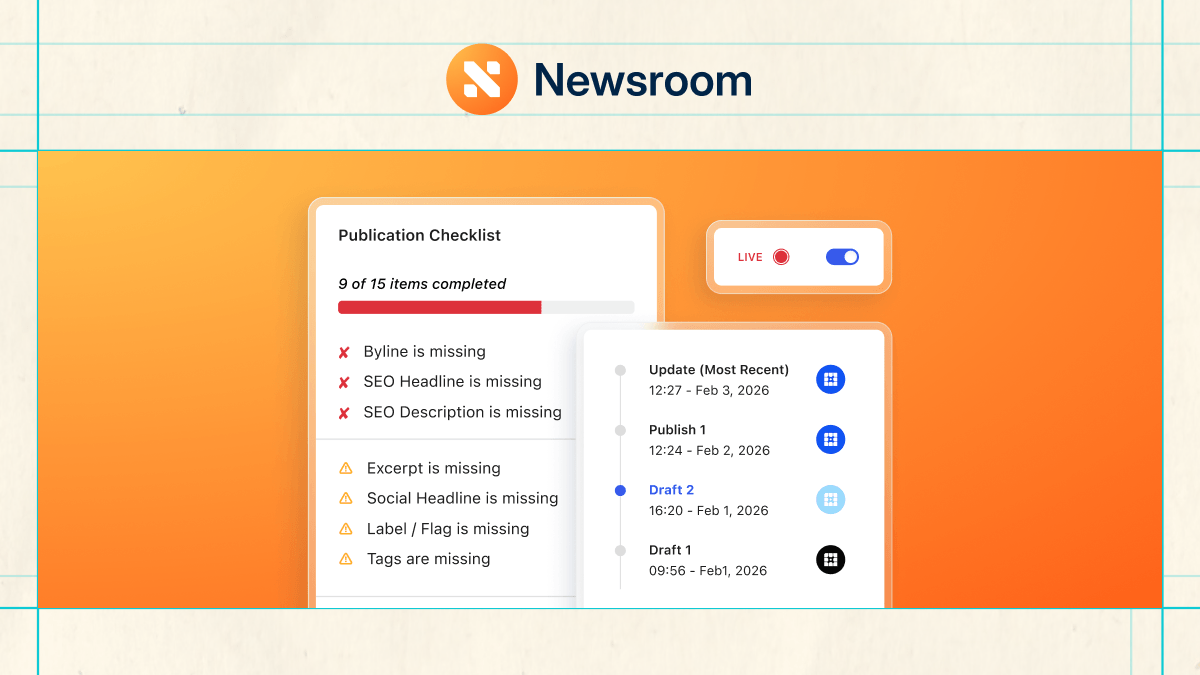
An integrated publication checklist is a must-have feature for any CMS used by newspapers or other news publishers. Rather than relying on a separate spreadsheet or Slack messages, the system should allow you to configure hard guardrails directly in the editor. For example, the “Publish” button remains inactive until specific criteria—like a featured image, a legal review tag, or a primary category—are met. This ensures brand standards are upheld across every vertical without requiring constant editorial oversight.
Collaboration tools
The writing experience should be clean and focused, but a news article requires more than just words. It needs metadata, social distribution settings, and media assets. When all these controls are shoved into a single, cluttered sidebar, it can lead to “UI fatigue” and slower publishing times.
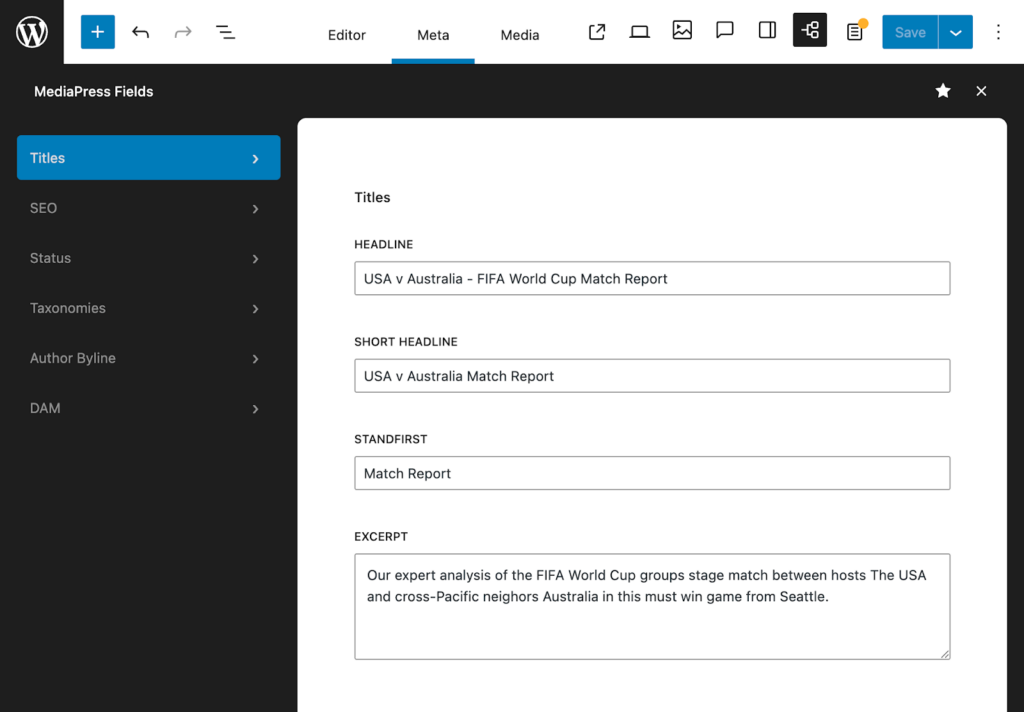
Modern news publishing platforms must solve this. WP Engine Newsroom separates different editorial functions into Editor Tabs within the WordPress editor. By separating the functions of editing, media management, and meta management into distinct, optimized views, teams can collaborate more effectively. An editor can finalize the copy in one zone while a social media manager optimizes the Open Graph tags in another, ensuring no one is stepping on the other’s toes.
Live news capabilities
Breaking news takes place on its own schedule. During elections, sporting events, or breaking stories, the audience demands to-the-minute updates. Traditionally, “live blogging” required a third-party service that lived outside the CMS, which often hurt SEO, created a disjointed user experience, and was difficult to use.
A better solution includes features that help you manage live news innately, allowing reporters to publish “micro-posts” or chronological updates within a single article container. These updates should render instantly on the frontend without requiring a full page refresh, keeping your time-on-site metrics high and your audience engaged.
Newsroom includes a native Live feature that provides a streamlined UI for creating chronological entries and a dedicated block to render the live feed for your audience in real time.
Safety nets for unpublished content
One of the most common pain points for high-volume publishers is the inability to update a live story without those changes going public immediately. If an editor needs to spend 30 minutes updating a developing story with new facts, they shouldn’t have to work in a separate draft, wait for the all-clear, and then copy-paste changes to the live version.
Newsroom changes the game by giving you the ability to save Unpublished Edits to a live post. It allows your team to work on the next version of a story in the background, preview it in the actual site layout, and then swap it with the live version when the time is right.
Media and DAM integration
For a newsroom producing dozens or even hundreds of stories a day, the WordPress Media Library can quickly become a graveyard of unorganized files. High-volume teams need a publishing platform that plays well with enterprise Digital Asset Management (DAM) systems.
Instead of downloading an image from a corporate server and re-uploading it to the CMS, a modern workflow allows editors to search, crop, and insert assets directly from the DAM within the editor interface. This ensures teams only use licensed, high-quality assets and eliminates the storage bloat of duplicate files.
Newsroom streamlines this entire process with a dedicated media management interface and first-class DAM integrations, allowing your team to search, edit, and insert assets from DAM platforms directly within the WordPress editor.
Actionable analytics, not vanity metrics
Standard pageview counts don’t tell the full story of reader intent. To drive subscriptions and retention, newsrooms need to understand how people are consuming content.
Your CMS should integrate deeply with behavioral analytics. Features like heatmaps and session recordings show exactly where readers drop off, while conversion funnel tracking helps editors see which specific articles are actually driving newsletter signups or paywall conversions. When these insights are available directly within the CMS, editorial teams can make data-driven decisions in real time.
In the case of Newsroom, this process is simplified by integrating advanced behavioral analytics directly into the dashboard. Powered by TWIPLA, it gives your team immediate access to heatmaps, session recordings, and conversion funnel data without ever leaving the CMS.

Unified solution
The single biggest cost of managing a sprawling, disconnected tech stack isn’t the monthly subscription fees. It’s the loss of agility. When your editorial team is focused on the “how” of publishing rather than the “what” of the story, growth stalls.
This is why we built Newsroom.
Newsroom is designed to check every box on this list without requiring a team of developers to stitch together disparate plugins. Unifying editorial workflow tools (like Checklists and Editor Tabs), rich content features (like Live News and interactive Polls), and deep behavioral analytics into a single system removes the most common sources of friction from the publishing process.
If your newsroom is ready to stop managing software and start focusing on the story, it’s time to look at a publishing platform built for the reality of modern media.
Don’t let your technology dictate your editorial speed. Discover how Newsroom provides the tools, the data, and the stability your newsroom needs to lead the pack.