Get Started


Key Takeaways
Moving beyond simple text generation to complete AI content operations enables enterprise editorial teams to automate manual tasks across the full publishing pipeline, from research and briefing to analytics.
Rapidly scaling AI draft volume shifts the primary publishing bottleneck from content creation to editorial review and quality assurance.
Unapproved “shadow AI” tools create severe security risks, brand inconsistencies, and stack fragmentation, requiring teams to implement clear AI content governance.
Safe AI scaling requires three operational pillars: standardized prompt libraries, mandatory human-in-the-loop review gates, and connecting AI tools to verified repository data.
Editorial leaders should audit their existing publishing stack to consolidate workflows and establish clear governance rules before expanding AI adoption.
Content teams are often tangled in a web of software, switching between isolated AI writers, SEO optimization tools, and unvetted browser extensions.
These point tools enable rapid drafting, but they often lead to chaotic copy-pasting, version control errors, and unverified outputs across fragmented publishing workflows.
The goal of end-to-end AI content operations shouldn’t be to produce bad copy faster. Actually, scaling editorial operations requires using artificial intelligence as an operational engine to coordinate planning, research, compliance, and distribution.
Building a high-velocity publishing team requires three operational foundations:
- Clear governance: Establishing standardized standards, prompt practices, and review controls across your team.
- Connected technology stack: Unifying tools into a central publishing platform to eliminate silos and software fragmentation.
- Human oversight: Ensuring editorial expertise and subject matter checkpoints anchor every stage of the content lifecycle.
In this guide, I look at how to modernize your publishing model without compromising quality or security.
What are AI content operations?
AI content operations are the processes and systems used to apply artificial intelligence across the content lifecycle. They combine AI with existing workflows, technology, and governance to support tasks such as planning, creation, review, publishing, analysis, and optimization while maintaining appropriate human oversight.
AI generation vs. AI operations
There aren’t many points of comparison between AI content generation and AI content operations. Forget comparing apples to oranges. This is more like comparing a bushel of apples to the abstract concept of justice.
Generative AI focuses narrowly on prompting a model to produce words, code, or images. AI content operations instead encompass the entire publishing pipeline. Generating copy or images is the least important and least useful part of it.
Consider the process underlying any piece of content. It starts with initial ideation and ends with performance analysis and the decision to update, leave it alone, or junk it.
Between initial ideation and performance analysis lie many tedious, time-consuming steps. The real way AI content operations lets you scale is by automating as many of those tedious tasks as possible.
Are you ready to add AI to your content operations?
Introducing AI automation assumes a certain baseline of operational maturity.
AI adoption tends to accelerate existing processes. If your underlying workflow is chaotic, AI will give you even more chaos, and it will come at you faster.
You should have at least three things in place before you even consider AI content operations:
- People and ownership: Defining clear single-approver roles and editorial responsibilities for every content stage.
- Process clarity: Mapping a documented, repeatable workflow with unambiguous entry and exit criteria.
- Technology and repositories: Centralizing assets into a unified source of truth rather than scattered drives and chat apps.
There is such a thing as overengineering.
Get that locked down before trying to scale with automation.
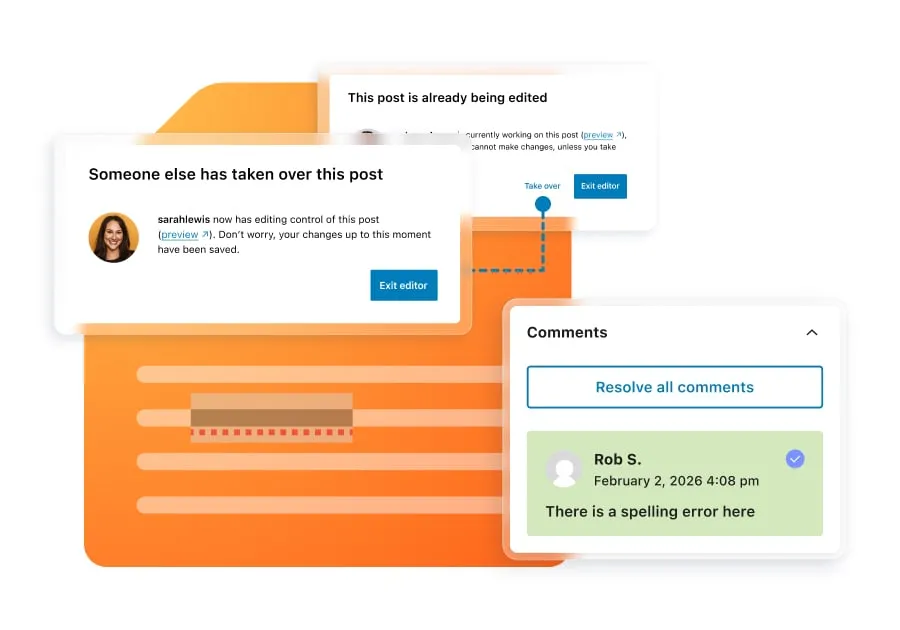
Take control of your content operations
Don’t let AI fragment your content stack. Discover how WP Engine Newsroom provides the connected, governed foundation enterprise teams need to scale modern content operations.
Why AI content operations matter for generative discovery
AI content operations go beyond internal efficiency, directly impacting your external visibility. Content visibility is no longer limited to traditional search engine rank and click-through rates. Discovery has expanded into answer engines, LLM-powered systems like ChatGPT, Perplexity, and Google AI Overviews.
Traditional search picked up your title, metadata, etc. Answer engines extract, synthesize, and cite information directly from across the web. Your goal with these is to ensure they cite your content specifically.
Generative engines cannot cite or surface what they cannot parse. Beyond managing internal workflows, content operations must enforce machine-readable content architecture. This means organizing assets into modular sections, incorporating clear extractable facts, and applying consistent semantic formatting so AI discovery models can easily read, trust, and reuse your brand’s content.
A good rule of thumb is to fix your primary review bottleneck first before automating any stage.
The 5 stages of the AI-enabled content lifecycle
Integrating AI across an established content operations framework ensures every phase of publishing benefits from automation while preserving human judgment:
Stage 1: Planning and ideation
AI systems analyze search volume trends, conversational prompt patterns, and audience intent models to identify high-value topic gaps. Rather than relying on guesswork, managing editors can use predictive models to determine what topics your target audience is actively querying across both search engines and conversational LLMs.
- Operational Example: Scraping prompt databases and customer support logs to spot emerging user questions, then mapping them directly to content cluster gaps before competitors cover them.
Stage 2: Research and briefing
Automated routines scan existing repository assets to prevent duplicate coverage, aggregate competitor SERP insights, and generate comprehensive editorial briefs. This reduces the manual labor required by strategists while ensuring writers receive consistent baseline specifications.
- Operational Example: Running an automated internal audit against your existing WordPress®1 library to pull internal linking recommendations and surface outdated statistics that need to be refreshed.
Stage 3: Drafting and production
Writers leverage AI as a collaborative assistant to construct structured outlines, draft repetitive structural elements, or synthesize complex technical research. AI acts as an accelerator for the writer rather than a replacement, allowing human creators to focus on original insights, tone, and narrative depth.
- Operational Example: Feeding a 45-minute transcript from an internal subject matter expert (SME) into an AI tool to extract key quotes, summarize technical definitions, and generate an initial draft skeleton.
Stage 4: Governance and QA
Automated rule engines test code snippets, enforce style guidelines, and verify machine-readable structures like modular headings, bulleted facts, and semantic schema. This ensures content can be easily parsed and cited by generative engines before reaching human review. Conveniently, these machine-readable structures also make articles significantly easier for human eyes to skim and digest.
- Operational Example: Setting up automated pre-publish checklist rules in your CMS that flag passive voice, verify target keyword usage, validate code block syntax, and check for missing alt text before an editor ever opens the file.
Stage 5: Analytics and optimization
Post-publish analytics track content performance metrics, detect traffic decay, and trigger automated update alerts for older assets. AI closes the loop on the content lifecycle by continuously monitoring live assets and identifying exactly when a piece of content requires a refresh.
- Operational Example: Configuring automated alerts that flag high-traffic posts experiencing a 15% drop in organic impressions quarter-over-quarter, automatically creating a refresh ticket with updated competitor keyword data.
The governance imperative: Keeping humans in the loop
As publishing velocity increases, AI content governance serves as the strategic operating system connecting corporate business goals to daily execution.
Governance defines not just how content is reviewed, but why it is produced. This ensures every AI-assisted asset directly supports organizational KPIs rather than generating output for output’s sake.
Automated tools can assist in drafting and auditing, but human-in-the-loop oversight remains essential for strategic alignment, editorial intuition, and legal accountability.
Organizations adopting a forward-thinking digital publishing AI strategy build explicit human-in-the-loop” checkpoints.
Every piece of content must pass through designated approval gates where subject matter experts and senior editors review factual accuracy, tone, and alignment with corporate messaging. Single-approver accountability prevents review delays while ensuring unvetted content never reaches live audiences.
The governance bottleneck in AI content operations
AI models make it trivial to produce dozens of draft articles in minutes.
Now you’ve got dozens of drafts to edit with a fine-toothed comb to ensure you’re not exposing yourself to brand liability or libel laws.
The surge in volume exposes the real bottleneck in modern digital publishing: editorial review and quality assurance.
When draft output explodes without operational guardrails, editors become overwhelmed by fact-checking, style enforcement, and legal sign-offs. The primary constraint of modern publishing has shifted from content creation to content approval.
The three pillars of safe AI scaling
Governance is not a late-stage add-on. It is the foundational starting requirement for scaling content operations. Before introducing automated workflows, managing editors must establish three core pillars to serve as guardrails:
- Approved models and shared prompts: Standardize toolsets across teams to eliminate unvetted software and maintain brand voice consistency.
- Human-in-the-loop review gates: Establishing non-negotiable sign-off checkpoints before any draft moves to publishing.
- Single source of truth: Connecting AI systems directly to verified repository data rather than open, unvetted web searches.
Adapting AI content operations governance to your organization
Organizational structure directly dictates how AI content operations are deployed, monitored, and scaled. Governance must adapt to how your teams interact with AI technology:
| Organizational model | AI content operations approach | Key advantage | Primary AI governance risk |
| Centralized | A single core team manages all AI prompt templates, tool selection, drafting, and publishing workflows. | Maximum brand voice control, prompt standardization, and data security enforcement. | Severe operational bottlenecks as content volume scales across departments. |
| Decentralized | Business units independently select AI tools, write custom prompts, and publish content. | High publishing velocity and localized messaging agility. | Widespread “shadow AI” adoption, data leakage, and erratic brand compliance. |
| Hybrid (Federated) | A central Ops team sets AI guardrails, approved models, and CMS integrations, while local teams execute drafting within those rules. | Balances localized creation speed with central quality and compliance guardrails. | Requires continuous alignment between central ops and regional editorial leads. |
The hybrid model provides the safest architecture for organizations scaling AI content operations. It enables publishing speed while anchoring workflows in centralized compliance and editorial guardrails.

Evaluating your next publishing platform?
Choose a platform that can evolve with your operations without accumulating unnecessary complexity. Explore a smarter way to compare the capabilities that matter when assessing enterprise publishing platforms.
How to introduce AI without fragmenting your tech stack
Step 1: Audit and eliminate shadow AI
Give your editorial team a tool and they’ll probably use it. Don’t give them a specific tool, and they’ll most likely default to using shadow AI. Shadow AI is a very cool name for a decidedly uncool process: using personal accounts, unapproved browser extensions, and isolated web tools.
This gives highly variable results, but that’s not the major issue. It also introduces severe operational risks, including proprietary data leakage, copyright exposure, erratic brand voice, and lost revision history.
- Action item: Conduct an immediate inventory of the browser extensions, personal accounts, and unvetted AI tools across your team, and replace them with enterprise-approved software.
Step 2: Define governance rules before selecting tools
Purchasing a new AI tool will not fix a fundamentally broken content operation. Technology adoption must follow governance, not precede it. Define your strategic goals, role accountability, and workflow entry/exit criteria first. This will put you in a good position to select connected platforms that support and automate those established rules.
- Action item: Document your team’s strategic goals, single-approver roles, and workflow entry/exit criteria on paper before issuing an RFP or evaluating new software vendors.
Step 3: Replace isolated point solutions with a connected foundation
Adding single-purpose software to an already bloated stack increases operational complexity and technical debt. This is above and beyond any risks introduced by shadow AI.
If you’re looking to reduce technical debt, then one of the first steps should be to avoid relying on isolated point solutions that trap content in disconnected silos.
- Action item: Identify point solutions that isolate content in external silos, and consolidate your drafting, SEO, and review workflows directly within a central CMS platform.
Connecting your content operations with WP Engine Newsroom
Rather than acting as an unvetted text generator, WP Engine Newsroom provides the connected publishing foundation that unifies your AI content workflow. By consolidating multi-author collaboration, role-based permissions, publication checklists, and centralized governance directly inside WordPress, Newsroom ensures that all AI-assisted research, drafting, and optimization flow into a single, secure source of truth.
FAQs about AI in content operations
What is the difference between AI content generation and AI content operations?
AI content generation refers specifically to using LLMs to write text or create media assets from prompts. AI content operations encompasses the entire end-to-end publishing infrastructure, including planning, research, workflow routing, governance, compliance, publishing, and performance tracking.
How do you prevent AI tools from creating tech stack fragmentation?
Prevent fragmentation by anchoring AI execution in a central publishing platform rather than relying on disconnected point solutions. Establishing standardized prompt libraries, approved toolsets, and unified CMS workflows ensures content remains centralized and governed.
What role should human editors play in an AI-assisted workflow?
Human editors serve as essential review gates responsible for fact-checking, tone enforcement, subject matter verification, and final sign-off. AI augments research and production, but human judgment remains non-negotiable for quality assurance and editorial accountability.
How do AI content operations affect visibility in AI answer engines?
Traditional SEO focuses on blue links and keyword density, whereas generative discovery relies on machine-readable structure and semantic clarity. By embedding structured formats, explicit facts, and clear heading hierarchies into your editorial operations, you ensure LLMs and answer engines can accurately extract and cite your content in generative search results.
- WP Engine is a proud member and supporter of the community of WordPress® users. The WordPress® trademark is the intellectual property of the WordPress Foundation. Uses of the WordPress® trademarks in this website are for identification purposes only and do not imply an endorsement by WordPress Foundation. WP Engine is not endorsed or owned by, or affiliated with, the WordPress Foundation. ↩︎