Get Started


Key Takeaways
Fragmented publishing workflows happen as a result of growth, as enterprise newsrooms introduce new tools, processes, and ways of working to support complex editorial operations.
The cumulative effect of disconnected systems, approval stages, and editorial workflows creates bottlenecks that reduce visibility, slow publishing, and make collaboration more difficult across teams.
Standardizing publishing workflows doesn’t mean removing flexibility. It’s about creating a consistent framework that supports content governance, collaboration, and efficient publishing while allowing teams to meet different editorial needs.
Editorial workflow software like WP Engine Newsroom helps enterprise publishers manage complexity by embedding publishing standards into the newsroom workflow and connecting the wider publishing ecosystem rather than adding another disconnected tool.
As editorial operations mature, it’s common for publishing workflows to become fragmented across teams, processes, and systems, creating points of friction that can be difficult to unpick.
The effects are felt throughout the entire publishing journey.
Fragmented workflows slow editorial teams, impede collaboration, and create inconsistencies in how content is reviewed, approved, and published.
While these challenges may seem operational, they can ultimately affect editorial quality, publishing velocity, and a newsroom’s ability to scale.
The answer isn’t necessarily to replace every tool or force every team into the same process. It’s to create a connected editorial workflow—one that brings people, content, compliance, and publishing systems together, so that teams can move faster without sacrificing control or quality.
What causes fragmented publishing workflows
Fragmentation isn’t usually the result of poor tech decisions.
More often, it’s the outcome of enterprise publishers quickly adapting to changing requirements while retaining the people, processes, and systems that continue to support the business.
As enterprise newsrooms evolve, they introduce new tools, processes, and ways of working to support changing editorial, commercial, and operational needs. Each addition increases the number of moving parts involved in publishing, making editorial workflows more difficult to coordinate.
Each decision solves an immediate need, but over time, editors can find themselves chasing feedback across email, Slack, and spreadsheets simply to move one story towards publication.
The ‘sticky-taped stack’ is what happens when years of plugins, integrations, and workarounds become the publishing platform. It’s not just a technical headache; it’s costing publishers time, money, and growth.
—Jason Konen, Director, Product, WP Engine
More sophisticated publishing processes
Publishing workflows grow to include additional review stages. Content that once moved directly from editor to publication may now pass through legal review, accessibility checks, SEO validation, brand approvals, and audience teams before it’s ready to publish.
Each additional stage is introduced for a valid reason, helping publishers improve quality, content governance, or compliance. Collectively, however, they make publishing workflows longer and more complex to manage.
Different editorial workflows across teams
Editorial workflows become more varied as teams grow, publishers launch new brands, expand into new markets, or acquire additional publications. Teams develop processes that reflect their own editorial structures, responsibilities, and publishing priorities.
These localized workflows often work well in isolation, but across a larger publishing organization, they can become difficult to align, making it harder to standardize editorial processes, maintain visibility, and apply governance consistently.
Growing ecosystems of specialist publishing tools
Enterprise newsrooms also rely on a growing range of publishing software. Alongside a newsroom CMS, teams may use separate platforms for collaboration, digital asset management, SEO, accessibility, analytics, and other editorial functions, each designed to support a specific part of the publishing process.
Introducing specialist software often improves individual workflows. The cumulative effect, however, is where fragmentation begins.
As more tools are adopted, content moves between multiple platforms, teams, and approval processes, making editorial workflows harder to coordinate, monitor, and standardize, even where every individual tool performs exactly as intended.
The true cost of fragmented workflows
In addition to the growing financial costs of implementing and maintaining multiple workflows, they can create bottlenecks that are often difficult to identify until they begin to affect editorial capacity.
They don’t always stem from major technical failures or inefficient teams. More often, they emerge when everyday publishing activities become disconnected from one another.
| Fragmentation | Editorial bottleneck | Operational impact |
| Content is managed across multiple publishing systems | Reduced visibility | Publishing slows as editors spend time locating content and tracking progress |
| Images and videos are stored separately from editorial workflows | Asset management delays | Publication is delayed while assets are sourced, reviewed, and approved |
| Editorial quality checks rely on processes outside of the publishing system | Disconnected quality control | Publishing standards become harder to maintain consistently across teams |
| Reviews and approvals take place across different tools | Manual coordination | Publishing timelines become harder to manage as teams chase feedback and sign-off |
| Editorial decisions are shared through emails, spreadsheets, and messaging platforms | Disjointed communication | Collaboration becomes less efficient as teams reconcile feedback from multiple sources |
| Publishing relies on individual knowledge rather than shared workflows | Knowledge silos | Workflows become more vulnerable to delays when key people are unavailable |
The issue isn’t that enterprise publishers use too many tools. Most specialist systems solve genuine editorial needs. The challenge is that they’re rarely designed to work as part of a single publishing process.
As information, approvals, and content move between disconnected systems, coordination becomes a manual task rather than something the workflow itself supports.

Planning to simplify your publishing workflows?
Step back and evaluate whether your publishing platform is helping reduce complexity—or adding to it. Explore a smarter way to compare the capabilities that support connected editorial workflows at scale.
Standardizing editorial workflows across enterprise newsrooms
Managing fragmentation doesn’t mean every team must work in exactly the same way. Enterprise publishers need workflows that are consistent where it counts, while allowing individual teams to accommodate different publishing requirements.
The objective isn’t to make every newsroom identical. It’s to remove the disconnects that create editorial bottlenecks while preserving the flexibility needed to support different brands, content types, and publishing models.
Create a shared editorial framework
Reducing fragmentation starts by establishing a shared editorial framework. Instead of every team creating its own publishing process, organizations should define a consistent approach to:
- Workflow stages and publishing milestones
- Editorial roles and responsibilities
- Review and approval processes
- Publishing standards and governance requirements
This creates a common foundation for editorial teams while still allowing flexibility where it’s needed.
Embed governance into editorial workflows
Standardization is as much an operational challenge as a technical one. Publishing tools should reinforce agreed workflows rather than allowing processes to diverge between teams.
When content governance, approval stages, editorial responsibilities, and publication requirements are embedded directly into the workflow, consistency becomes part of the publishing process rather than something that’s enforced afterward.
Improve visibility across the publishing process
Standardized workflows improve visibility by allowing editors to track every piece of content as it moves through the publishing process. Clear ownership at each stage, together with consistent reviews and approvals across brands and publications, makes workflows easier to coordinate.
As teams work within the same editorial framework, the need for manual coordination is reduced because ownership, progress, and next steps are clear throughout the connected editorial workflow.
What editorial workflow software should support
Editorial workflow software needs to do a lot more than just replace manual processes with digital ones. It should help enterprise publishers manage complex editorial operations while maintaining visibility, consistency, and control across the publishing process.
Flexible publishing workflows
Enterprise publishers often follow several publishing models, so workflows need to be configurable enough to accommodate different brands, content types, approval requirements, and editorial teams without forcing organizations into rigid processes that will likely lead to workarounds.
End-to-end visibility
Editors should be able to understand where content is in the publishing process, who owns the next stage, and which approvals are still outstanding. With a clear view of progress, teams don’t need to rely on email trails, spreadsheets, or messaging platforms to coordinate work from creation to publication.
Embedded governance
Editorial workflow software should support agreed publishing processes by embedding approval stages, editorial responsibilities, accessibility checks, SEO requirements, and publication checklists directly into the workflow. This makes it easier to maintain consistent editorial standards without introducing additional manual oversight or additional tools.
Connected publishing systems
Editorial workflow software also needs to sit within the wider publishing ecosystem rather than operating in isolation. The goal is to create a connected publishing environment where information moves with the content, reducing handoffs and helping work progress smoothly between systems.
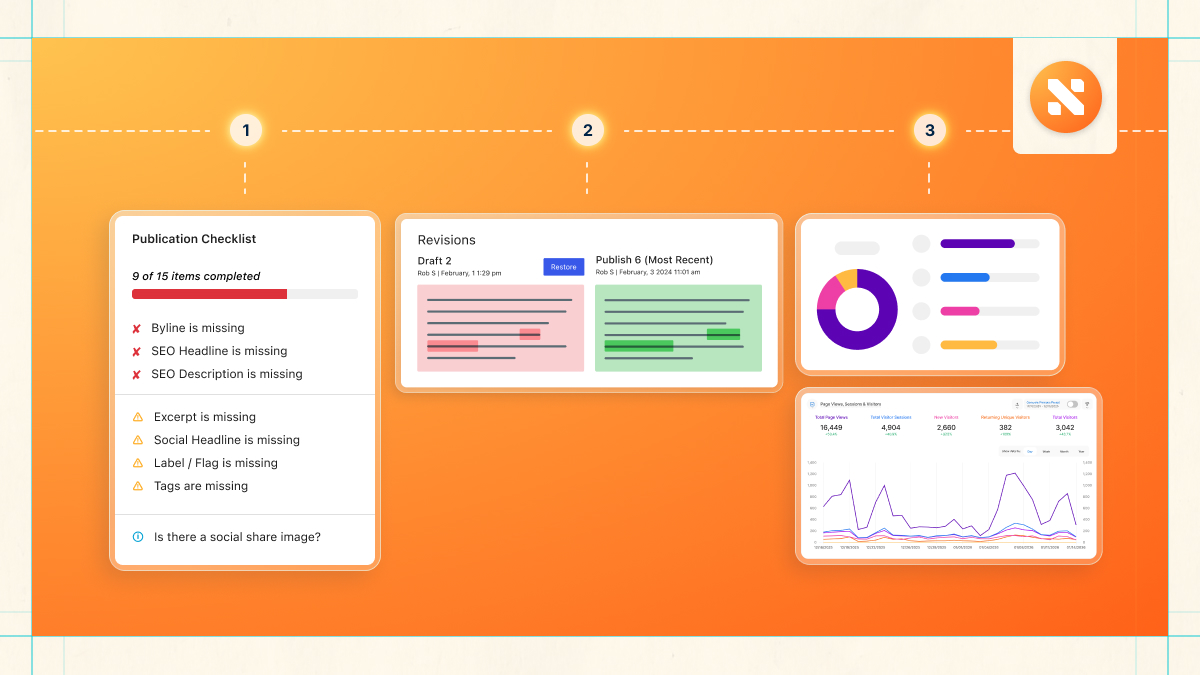
WP Engine Newsroom applies those principles by extending WordPress for publishers. Instead of relying on disconnected tools and manual coordination to move content forward, editorial teams can manage reviews, approvals, multi-author collaboration, and publication within a single publishing workflow.
Editors get a real-time view of every story’s progress without needing to chase updates across separate tools, and publishing standards are ingrained within the workflow.
By bringing those activities together, enterprise publishers can continue adapting their editorial operations without constantly redesigning the publishing process. As new teams, tools, and requirements are introduced, the workflow provides a consistent foundation that keeps content moving efficiently from creation to publication.